kakobuy Salomon XT-6 Spreadsheet Guide
kakobuy Salomon XT-6 Spreadsheet Guide
Editor's note: This article is generated based on structured platform data and evidence boundary checks; it does not represent actual purchase, fitting, or authentication experience. The method verification date is September 4, 2026; specific product prices, inventory, materials, sizes, seller authorization, return/exchange conditions, and link status may change, and must be re-verified on the day of ordering.
This guide addresses a specific problem: when facing similarly named Salomon XT-6 candidates in the kakobuy Spreadsheet, how to narrow down step by step based on wearing task, foot shape, size data, upper and sole information, and decide whether to keep, request additional photos, return/exchange, or abandon at the warehouse inspection stage.
It is not suitable for buyers who only judge authenticity from images, require a guaranteed fit, or need to receive goods by a fixed date. The Spreadsheet, product pages, and QC photos can only provide partial evidence and cannot replace brand authorization records, physical try-on, or professional authentication.
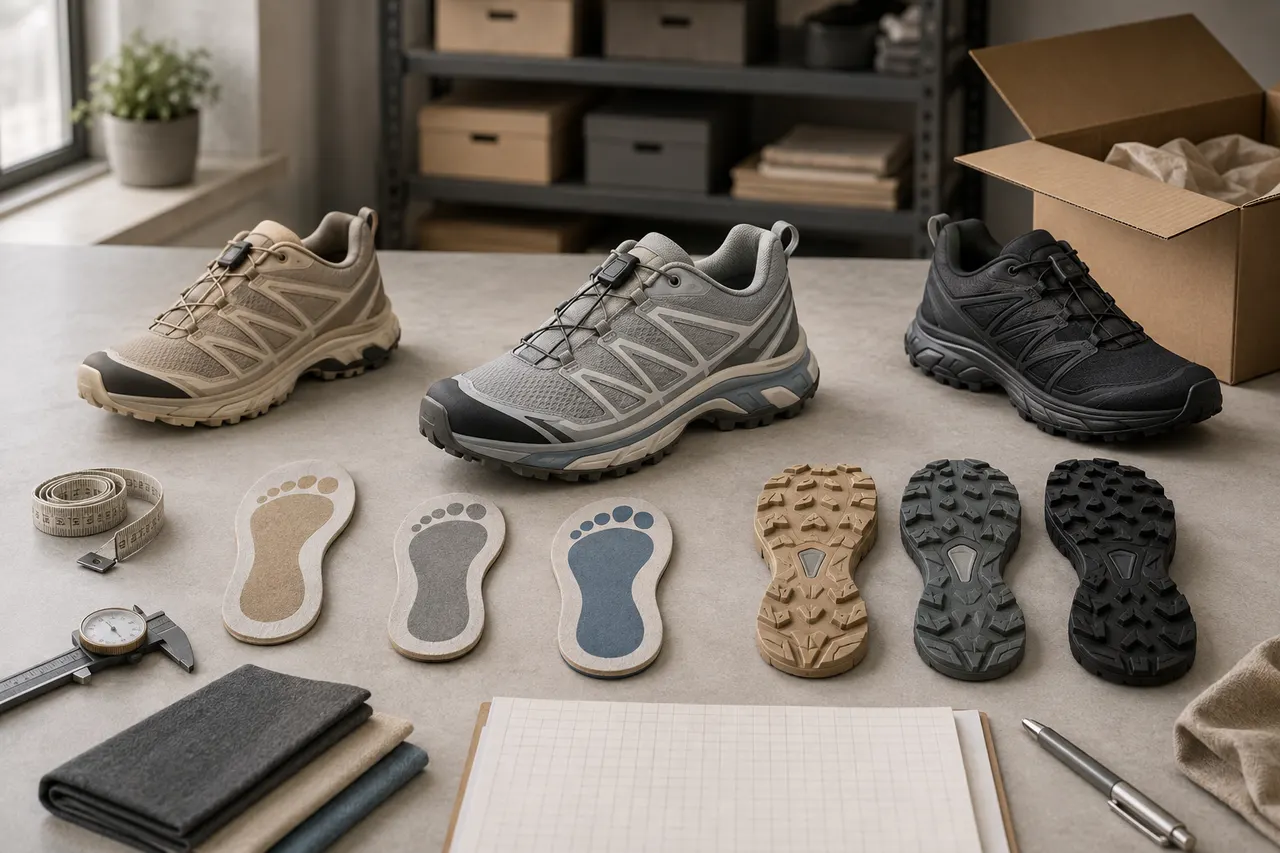
Caption: Start with wearing task, foot shape and size, then check version information and warehouse photos.
First confirm the wearing task: commuting, travel, or light outdoor
Don't start with colorways. Write down the main usage scenario first, because the same aesthetic preference will lead to completely different filtering criteria in different tasks. 👟
If mainly used for urban commuting, priority should be given to size stability, whether the upper is easy to clean, whether the sole structure is suitable for daily surfaces, and whether insoles need to be replaced for long periods of standing. For travel use, also consider luggage volume, consecutive days of wear, and rainy environments. For light outdoor scenarios, further check sole tread, upper coverage, toe protection, and route conditions, but cannot infer performance solely from the word "outdoor" in the product title.
Create a brief task card:
Main scenario: commuting, travel, or light outdoor, choose only one primary task
Single wearing duration: short trips or all-day walking
Common surfaces: indoor, urban pavement, wet and slippery roads, or gravel roads
Sock thickness: thin socks, regular sports socks, or thick socks
Non-negotiable items: such as wide foot space, low instep pressure, or replaceable insoles
If the use involves technical hiking, trail running, extreme weather, or safety requirements, you should not rely solely on the Spreadsheet and ordinary QC photos for decisions; instead, choose legitimate channels where the intended use, performance data, and sales authorization can be verified.
What the kakobuy Spreadsheet can provide and its evidence boundaries
The platform information on kakobuycom.org describes kakobuy as a purchasing agent platform that assists users in buying products from Chinese e-commerce platforms and provides warehousing, appearance quality inspection, and international shipping services. The role of the Spreadsheet in this process is to organize candidate entries, not to guarantee sellers, products, or brands. 🔍
A candidate record may contain product name, images, specification hints, price, or source links, but these fields all need to be cross-checked against the real-time product page. Even if a link opens, it does not mean that inventory, size, material, or return/exchange conditions remain the same as when the table was compiled.
Evidence can be divided into three layers:
Evidence layer | What it can help confirm | What it cannot confirm |
|---|---|---|
Spreadsheet record | Build candidate list, discover possible styles and sources | Real-time inventory, accurate version, seller authorization, or authenticity |
Real-time product page and seller responses | Same-day specifications, size chart, colors, shipping conditions, and return/exchange instructions | Whether the physical item completely matches the description, whether it fits |
Warehouse QC photos and additional shots | Arrival appearance, labels, left/right shoes, and visible details | Wearing comfort, internal structure, long-term durability, or authenticity conclusion |
If a candidate link redirects, shows an empty page, has no clear product name, or only leads to tags and search result pages, it should be marked invalid and excluded from the final comparison.
Initial size filtering using foot length, foot width, and insole length from shoes that fit well
Size filtering requires at least foot length and foot width, and ideally the removable insole length from a pair of well-fitting shoes. Relying only on the usual EU or US size can easily confuse different brands, lasts, and seller size charts. 📏
It is recommended to measure both feet at the end of the day while wearing the socks you plan to pair with the shoes:
Place your heel against a vertical wall and stand naturally with weight on your foot on a piece of paper.
Mark the position of the longest toe and measure the straight-line distance from the wall to the mark.
Measure the widest part of the forefoot and record left and right feet separately.
Use the longer and wider foot as the filtering baseline.
Take out the insole from a truly well-fitting shoe, record its longest length and forefoot width, but do not treat insole length as foot length.
Then check whether each candidate product provides centimeter-based inner length, foot length recommendations, width hints, and size conversion charts. If the seller only gives a single size number without explaining what it measures, record it as "insufficient size evidence" rather than applying a generic conversion.
Buyers with wide feet, high insteps, or who need orthotic insoles should also ask about forefoot space, whether the insole is removable, and how the effective inner length is measured. If the seller's advice conflicts with actual measurements, request clarification first; do not substitute "usually go half size up" experience for evidence.
Distinguish upper, lacing, and sole version information
The "version" in the Spreadsheet or seller title may be a seller classification, batch name, or community term, not necessarily corresponding to the brand's official version. When comparing, break it down into observable fields, don't just record a vague version name.
The upper part can check mesh areas, overlay shapes, toe cap coverage, heel structure, and color blocking. The lacing part should record lacing system, hardware, lacing path, and left-right consistency. The sole part should observe outsole tread, partition boundaries, heel profile, and visible side structures separately.
If two candidate pages use the same promotional images but give different version names, treat them as not yet distinguished. Only proceed with comparison when the seller provides corresponding physical photos, specification explanations, or verifiable product code information.
For products with Salomon trademarks, model names, or similar logos, product images and labels alone cannot prove authorization or authenticity. If the buyer's core requirement is authenticity guarantee, obtain verifiable sales authorization, purchase proof, and return/exchange commitment before payment; if evidence is missing, it is safer to abandon the candidate.
Compare specification completeness and seller source of candidate links
The focus of filtering is not to find the page with the most fields, but to determine whether key fields corroborate each other. It is recommended to keep only three to five candidates and record for each:
Real-time product name and access date
Whether seller or store source is clear
Whether available sizes, colors, and so-called versions are explicit
Whether centimeter-based sizing basis and measurement instructions are provided
Whether product images correspond to the selected specifications
Whether domestic shipping fees, return/exchange restrictions, and estimated shipping time are visible
Whether returns/exchanges are allowed after warehouse inspection, and who bears the costs
Candidates with lower prices but missing size basis, version explanation, and return/exchange conditions may have higher risk costs than the apparent price difference. Do not treat old prices in the Spreadsheet as final prices, and do not use visitor counts, vague reviews, or "same style" tags as substitutes for seller source verification.
Use QC photos to check shoe shape, left-right symmetry, and label information
According to the platform information provided this time, kakobuy's regular inspection mainly checks visible information such as style, quantity, color, size, and model. This service boundary means buyers need to save their own checklist before ordering to avoid making decisions solely based on overall impression after receiving photos. 📷
When viewing QC photos, check in a fixed order:
Confirm that the photo shows both left and right shoes and matches the ordered color and size.
Compare toe shape, upper partitions, lacing path, and heel height for obvious asymmetry.
Look at the outsole photo, check tread, partitions, and visible contamination or damage.
Check the size labels on both shoes, confirm size, product code, or other visible codes are consistent.
Inspect glue marks, loose threads, impressions, obvious color differences, and missing accessories, but distinguish between lighting and actual defects.
Compare QC photos item by item with the product page screenshots saved when ordering, do not rely on memory.
QC photos cannot prove inner length, foot feel, cushioning, grip performance, or durability, nor can they complete authenticity identification based on a few appearance details. If key areas are not photographed, request additional photos with clear angles and measurement references, rather than vaguely asking for "more photos."
Record missing evidence and decide on additional photos, changing styles, or abandoning
Each missing item should correspond to an action. ✅
Situations suitable for additional photos include: blurred labels, outsole not shown, inconsistent angles of left and right shoes, or need to show insole length with a ruler. Additional photo requests should specify measurement start and end points and shooting angles, otherwise the new photos may still not support a decision.
Situations suitable for requesting exchange or return include: visible size mismatch with order, wrong color, inconsistent left and right shoe labels, obvious damage, or substantial differences between actual structure and the saved page information at time of ordering. Keep order records, product page screenshots, QC photos, and issue annotations when submitting.
The platform information provided this time states that ordinary goods may be eligible for return/exchange service within 120 hours after warehousing, with exceptions for customized, restricted items, and those where packaging or accessories were requested to be removed. This policy is highly volatile and must be reconfirmed on the day of warehousing via order page or written customer service response; do not treat the date of this article as a promise for future orders.
It is more appropriate to abandon in any of the following situations: seller refuses to provide basic size basis; candidate source cannot be identified; brand authorization or authenticity evidence cannot meet your requirements; key defects cannot be ruled out through additional photos; return/exchange costs exceed acceptable range.
Organize the size and version checklist before completing the order
The final checklist should keep only one first choice and one backup. The first choice records selected size, color, observable upper and sole features, seller source, order date price, domestic shipping fee, return/exchange conditions, and planned QC angles. The backup is used only when the first choice becomes invalid, to avoid purchasing multiple candidates with insufficient evidence simultaneously.
Before payment, open the real-time product page again to confirm that specifications have not changed due to default options or page updates. After warehousing, immediately check QC against the checklist and complete additional photos or return/exchange decisions within the applicable processing window. Before international shipping, re-estimate costs based on destination country, package weight, volume, declaration requirements, and route restrictions; declare truthfully, do not use under-declaration, split shipments to avoid taxes, or circumvent inspections.
This method does not promise fixed savings. Avoidable costs should be calculated per order: wrong product price, domestic shipping, possible return/exchange fees, and international shipping for unsuitable goods, minus additional costs from additional photos or returns/exchanges. The added cost is filtering time, and waiting for additional photos may compress the return/exchange window.
This approach is suitable for commuter, travel, and light outdoor buyers who are willing to measure foot shape, save evidence, and inspect promptly after warehousing; it is not recommended for those who need goods urgently, cannot confirm import restrictions, require absolute fit, or treat brand authenticity as a non-negotiable condition but cannot obtain authorization evidence.
Agent platform shopping FAQ
1. What do QC photos mean at kakobuy?
Every drop-shipping service, including kakobuy, maintains a specialized quality control team. When your products reach the kakobuy warehouse, staff perform a quality inspection and take QC photos of your items. Typically, kakobuy captures three photos, and the team checks that the color, dimensions, specifications, and quantity align with your order. They also look for any quality defects. Note that this process does not cover electronic products; for electronics, only the outer appearance is examined. If kakobuy finds quality issues or wrong size or color, the team promptly asks the seller for a return. This way, kakobuy ensures you receive high-quality products.
2. What should I do if I am not satisfied with an item received through kakobuy?
Reach out to kakobuy customer service without delay. For Chinese sellers, most non-specialty goods have a 5-day no-questions-asked return and exchange policy. If you are unhappy, you can ask for a return. If the package has already been shipped from the kakobuy warehouse to your address and you later discover a quality problem, contact kakobuy customer service so they can help you communicate with the seller to arrange compensation.
Below are the customer service email addresses for each platform:
kakobuy: [email protected]
oopbuy: [email protected]
usfans: [email protected]
hipobuy: [email protected]
superbuy: [email protected]
3. How can I check kakobuy QC photos?
When you review kakobuy QC photos, pay attention to the particular features of the item you ordered. For shoes, examine key areas such as the toe, heel, and tongue to check stitching, shoe structure, and tongue thickness so you can determine if it is a high-quality pair. For clothing, inspect the collar label, logo embroidery, fabric, and the neatness of the collar and cuffs, among other details.
Browse our latest products and find your next favorite item.